Research
Bar resonances in the stellar halo of a cosmological simulation

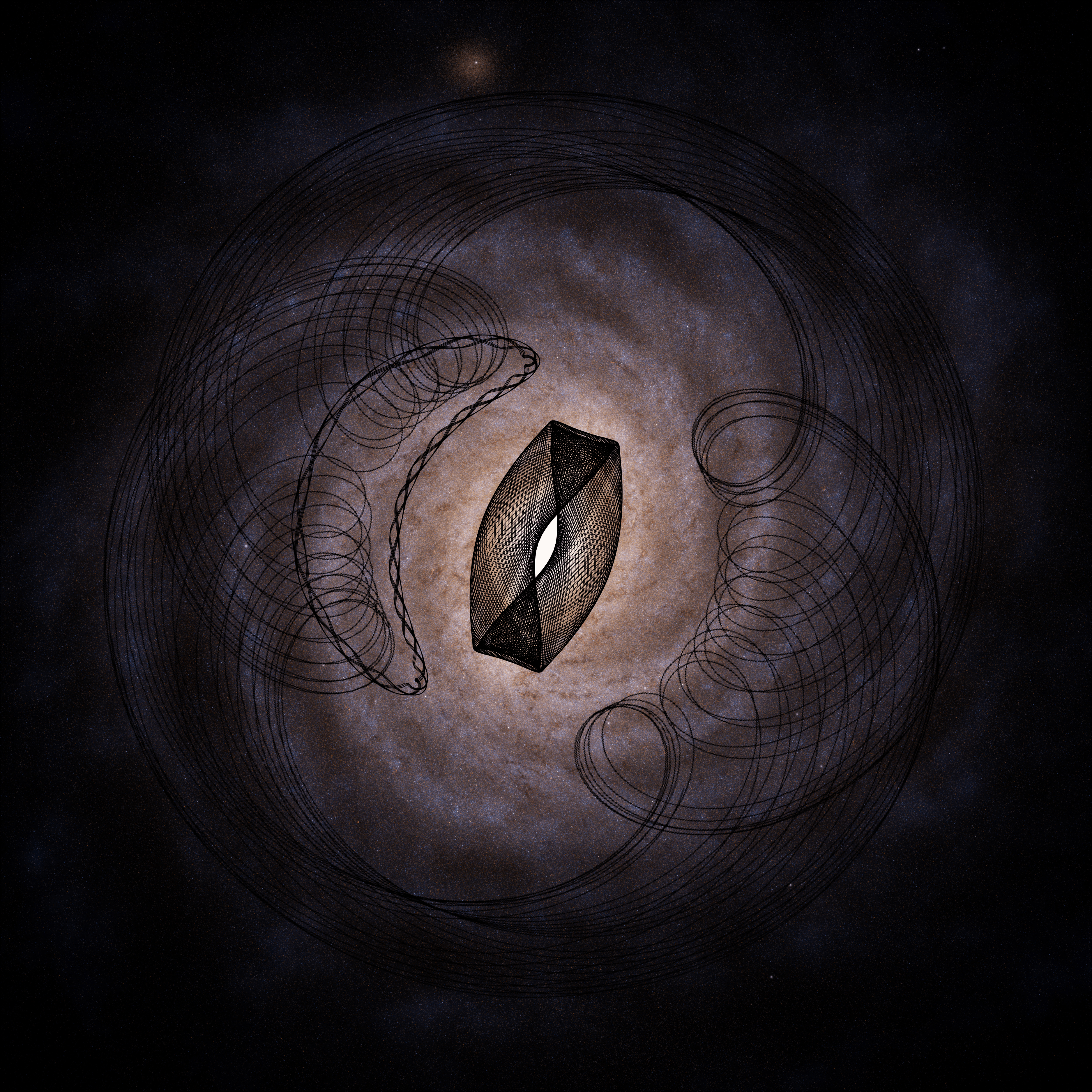
Most spiral galaxies, including the Milky Way, host a stellar bar. This elongated structure introduces a non-axisymmetric gravitational potential that exerts torques on the surrounding stellar disk and halo. Through these torques, angular momentum can be exchanged between different galactic components. This exchange occurs at specific orbital frequencies that are in resonance with the pattern speed of the bar. Stars on resonant orbits respond coherently to the bar’s gravitational perturbation and can therefore share similar orbital properties. As a result, these stars may appear as overdensities in spaces defined by integrals of motion, such as energy and angular momentum. The image on the left illustrates three examples of such resonant orbits.
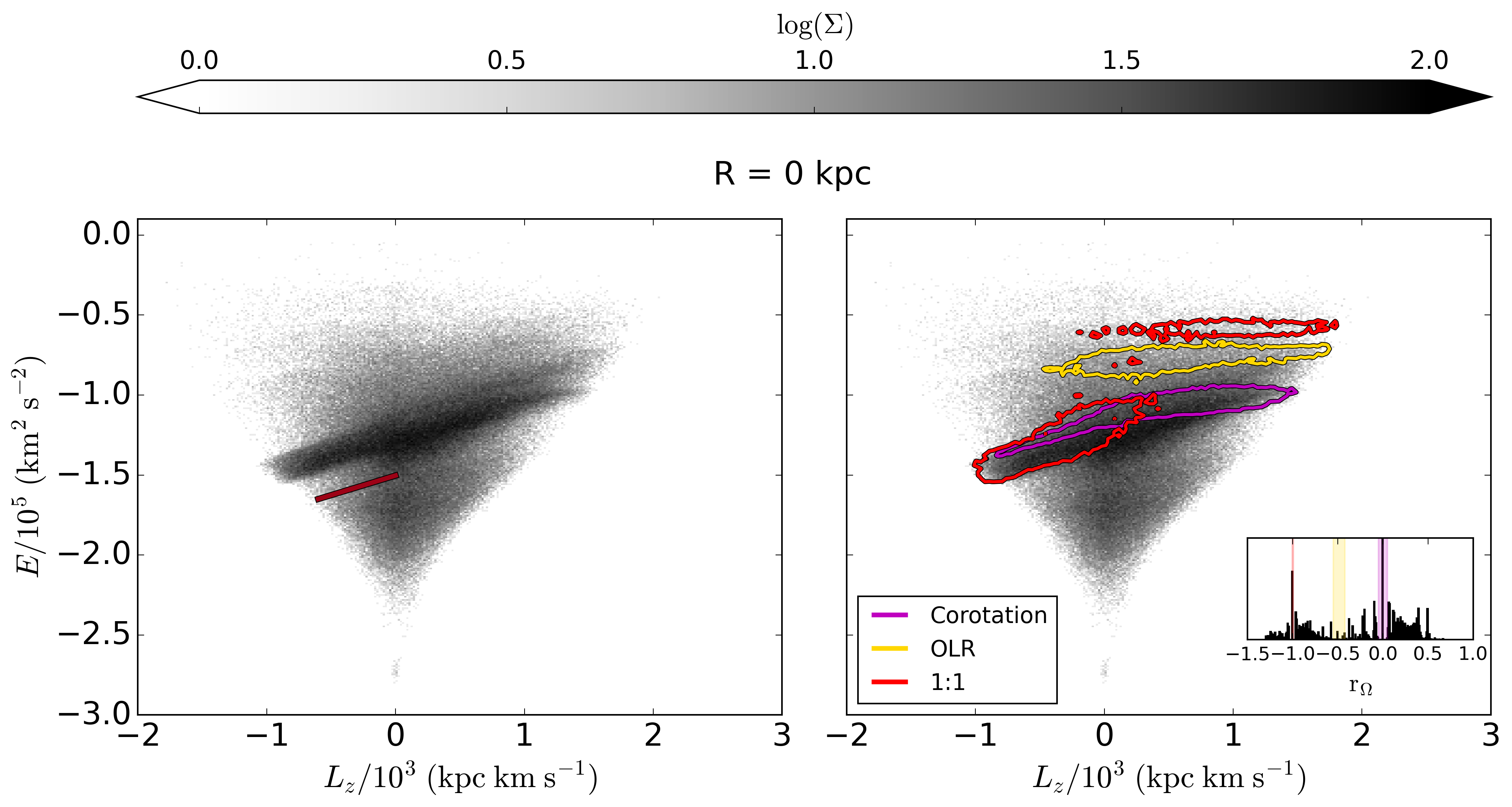
The second plot shows an example of such an overdensity in a cosmological simulation. These simulations allow us to distinguish between stars that formed in situ within the galaxy and those that were accreted through mergers with satellite galaxies. We find that this overdensity is particularly prominent in the accreted stellar population. However, it is not associated with any specific merger event; instead, it is produced by the galactic bar, specifically through the corotation and retrograde 1:1 resonances. Structures like this can complicate the search for past accretion events in the Milky Way’s history, as internally driven dynamical processes can create overdensities that resemble the signatures of past mergers.
Digging into the heart of the Galaxy to uncover its history
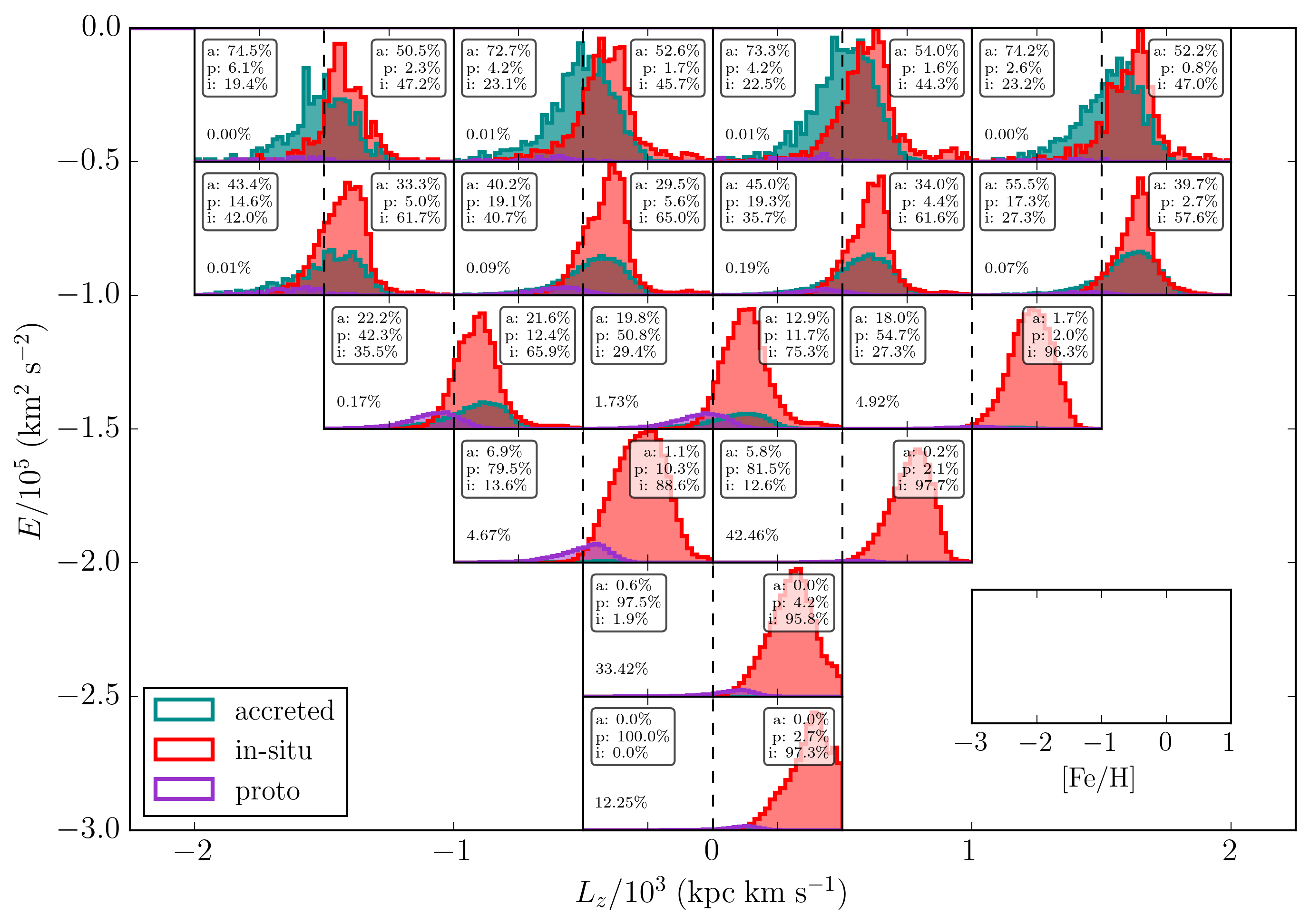
The centre of our Galaxy holds key clues about its earliest formation. This is why current and upcoming surveys are probing ever deeper into the heart of the Milky Way. To better understand what we can expect to observe, I use cosmological simulations to characterise its central region. This is where we can find some of the oldest and most-metal poor stars of the Galaxy, and thus clues about the Milky Way's earliest assembly. At very early times, the proto-galaxy is formed by rapid mergers of progenitors with similar masses. Due to this they also have very similar chemical enrichment, which makes it difficult to disentangle the building blocks of the Galaxy. It is further difficult to disentngle this proto-galaxy component from later early mergers, as these are found in similar regions of phase-space and have populations with chemistry similar to the proto-galaxy. The figure above shows the contributions of stars from the proto-galaxy, those formed in the main halo (in situ), and accreted stars in different regions of energy and angular momentum space. While in-situ stars are found throughout the central region, applying a metallicity cut can effectively reduce the number of in-situ stars. Proto-galaxy stars dominate at low energies and very low metallicities. Focusing on high-energy, low-metallicity stars appears to be the most promising way to identify accreted stars near the Galactic centre.